Tell us about the job
Takes about a minute. No obligation.
A heat pump running in this county has been carrying a real weather load, and that shapes what a contractor looks for before they can say what failed. 344 severe weather events were recorded in Linn County, Iowa between 2015 and 2024. At that rate, severe weather is part of the normal operating background for every system here, and wear on high-stress components reflects it. A contractor repairing a heat pump in Linn County checks the compressor, the reversing valve, and the electrical components for cumulative stress first, because those are the parts that absorb repeated hard-weather cycles. What they find there determines the repair scope.
Refrigerant lines crack, contactors corrode, and capacitors fail in ways that depend on how long a system has been running and what it was asked to do each season. Half the homes in Linn County, Iowa were built in 1978 or earlier (2020-2024 ACS 5-year). That means a contractor opening a heat pump here is working with components whose replacement parts may be discontinued, substituted, or available only through specialty suppliers. The electrical service feeding the unit also reflects what was standard across those earlier decades, and its condition affects whether a repair holds or reopens. What the opened system actually contains decides the scope and the bill.
The Parts of a Heat Pump a Contractor Checks First
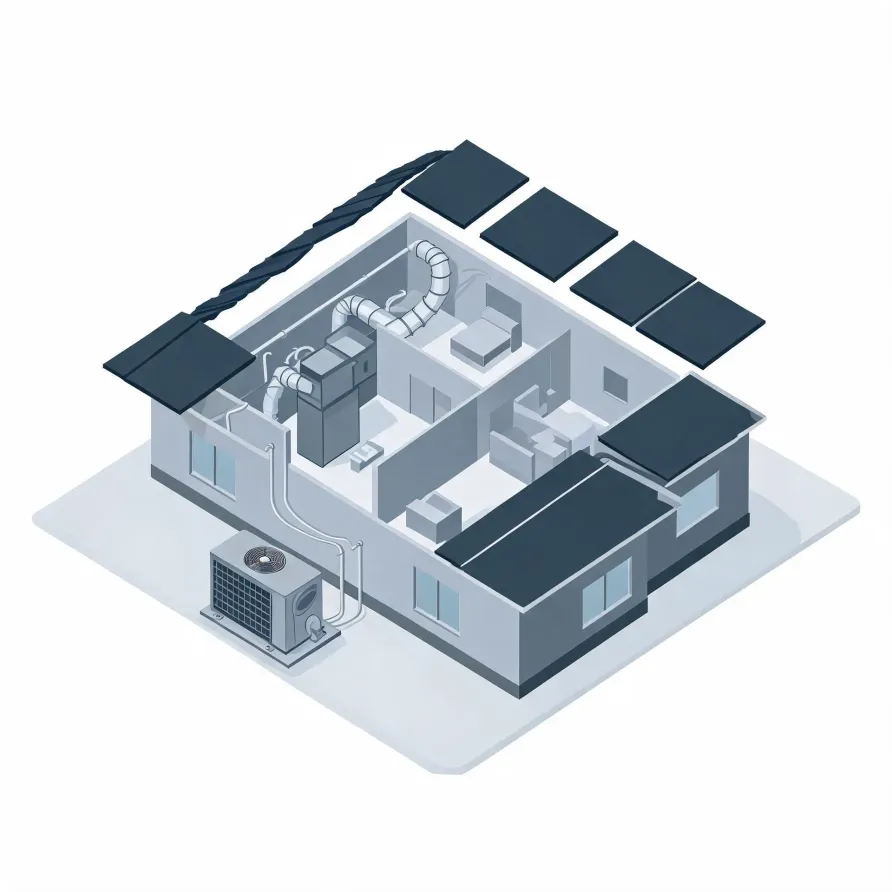
The outdoor unit is the piece most homeowners recognize, sitting on a concrete pad beside the house. Inside it, the compressor pressurizes refrigerant and the condenser coil transfers heat, and either one going wrong shows up as the system failing to warm the house. The outdoor fan pulls air across that coil, and a seized or sluggish fan motor is one of the first things a contractor puts eyes on.
Inside the house, the air handler holds the evaporator coil and the blower motor, usually in a utility closet, basement, or attic. The expansion valve sits between the two coils and controls refrigerant flow; a contractor checks it alongside the refrigerant lines that run between the indoor and outdoor units. The reversing valve, which shifts the system between heating and cooling, is another component that gets examined when the complaint points to one mode working and the other not.
The drawing shows the general layout of a heat pump system, and a licensed contractor determines which components and conditions apply to the specific house.
Get matched in Linn CountyLinn County, by the numbers
344 severe weather events were recorded in Linn County, Iowa between 2015 and 2024.
NOAA National Centers for Environmental Information, Storm Events Database, bulk CSV export, events 2015-01-01 through 2024-12-31.Half the homes in Linn County, Iowa were built in 1978 or earlier (2020-2024 ACS 5-year).
U.S. Census Bureau, 2020-2024 American Community Survey 5-Year EstimatesLinn County, Iowa holds 103,104 housing units (2020-2024 ACS 5-year).
U.S. Census Bureau, 2020-2024 American Community Survey 5-Year EstimatesOwners occupy 73.5% of the occupied homes in Linn County, Iowa (2020-2024 ACS 5-year).
U.S. Census Bureau, 2020-2024 American Community Survey 5-Year EstimatesCodes & Standards Governing Heat Pump Repair in Linn County, Iowa1 sourced rules and standards
Licensing and Legal Requirements in Linn County, Iowa
Iowa requires a state licence to install or repair HVAC, refrigeration, mechanical or plumbing systems, and to operate as a contractor, with exceptions listed in section 105.11.
Severe Weather Events in Linn County by Year
Extreme weather puts heat pumps under stress, and how hard a system works over its life is shaped by the conditions it faces locally. Repair needs in Linn County track that load, which is why local weather history belongs on a page about local service.
344 severe weather events, 2015–2024. Source: NOAA National Centers for Environmental Information, Storm Events Database.