Tell us about the job
Takes about a minute. No obligation.
Before a contractor can tell you whether a compressor died of age or something the weather drove it through, they have to know what this system has been running against. 142 severe weather events were recorded in Lee County, Iowa between 2015 and 2024. At that rate, severe weather is a standing condition here, and it shows up in repair work as accumulated stress on the parts that carry the load hardest: compressor windings, capacitors, and refrigerant lines that have been cycled hard through repeated weather events. A contractor working a heat pump repair in Lee County checks those components against that history before they quote anything.
Electrical service sized for an earlier generation of equipment shapes what a contractor finds when a heat pump stops working here. Half the homes in Lee County, Iowa were built in 1960 or earlier (2020-2024 ACS 5-year). That gap between when the house was built and what now runs in it means the internal components a contractor opens are often carrying wear that reflects decades of adaptation: contactors pitted from repeated cycling, refrigerant lines showing corrosion from connections made and remade over the years, wiring that was extended or spliced to reach something the original panel was never planned for. Parts availability is the other variable. A system running on older refrigerant or discontinued components may not have a direct replacement on the shelf, and the contractor's diagnosis has to account for that before a repair scope can be set.
The Parts of a Heat Pump a Contractor Checks During Repair
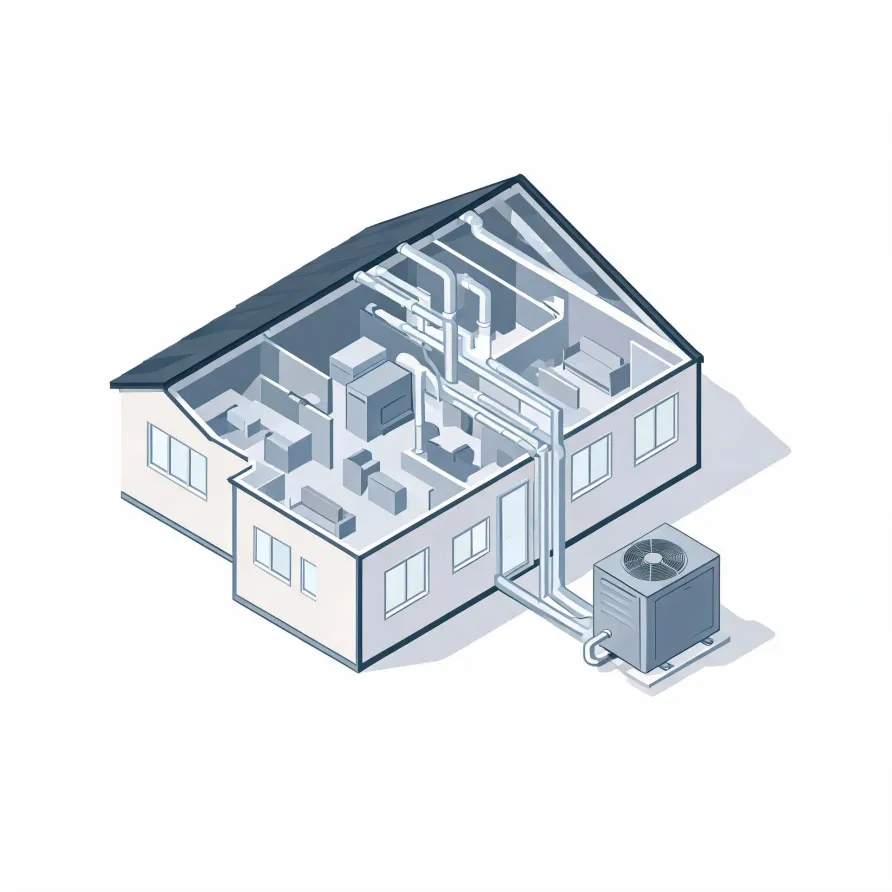
The outdoor unit is the piece most homeowners recognize on sight, sitting on a pad beside the house. Inside it, the compressor pressurizes refrigerant and the condenser coil releases or absorbs heat depending on the season. When either of those goes wrong, the whole system stops doing its job. The indoor air handler, mounted in a utility space or closet, holds the evaporator coil and the blower that moves conditioned air into the house. A contractor working a repair call will inspect both units, because a fault in one often shows up as a symptom in the other.
The refrigerant lines run between the two units and carry the working fluid that makes heat transfer possible. A leak anywhere along those lines causes the system to underperform or stop entirely, so a contractor checks the lines and their connections alongside the coils. The reversing valve, which sits inside the outdoor unit, is the part that lets a heat pump heat in winter and cool in summer. It is a common point of failure when a system blows the wrong temperature air.
The drawing alongside this text shows the general layout of a heat pump system, and a licensed contractor determines which components apply and what work is needed in your specific home.
Get matched in Lee CountyLee County by the Numbers
142 severe weather events were recorded in Lee County, Iowa between 2015 and 2024.
NOAA National Centers for Environmental Information, Storm Events Database, bulk CSV export, events 2015-01-01 through 2024-12-31.Half the homes in Lee County, Iowa were built in 1960 or earlier (2020-2024 ACS 5-year).
U.S. Census Bureau, 2020-2024 American Community Survey 5-Year EstimatesLee County, Iowa holds 15,794 housing units (2020-2024 ACS 5-year).
U.S. Census Bureau, 2020-2024 American Community Survey 5-Year EstimatesOwners occupy 76.3% of the occupied homes in Lee County, Iowa (2020-2024 ACS 5-year).
U.S. Census Bureau, 2020-2024 American Community Survey 5-Year EstimatesCodes & Rules for Heat Pump Repair in Lee County, Iowa1 sourced rules and standards
Licensing and Legal Requirements in Lee County, Iowa
Iowa requires a state licence to install or repair HVAC, refrigeration, mechanical or plumbing systems, and to operate as a contractor, with exceptions listed in section 105.11.
Severe Weather Events in Lee County
Weather puts a measurable load on heat pump equipment. How hard a system works over its life depends in part on what the local climate demands of it, which is why the conditions here in Lee County shape what repair needs look like.
142 severe weather events, 2015–2024. Source: NOAA National Centers for Environmental Information, Storm Events Database.