

Why your heat pump fan won't spin in Iowa
Why won't my heat pump fan spin in cold weather?
Cold snaps in Iowa put a heat pump through more than most people expect from a machine that also handles summer humidity. When the outdoor fan sits still on a freezing morning, it's natural to wonder if something's broken or if the unit is just doing what it's supposed to do. Catching the difference early matters, since a fan that won't spin can mean the whole system stops moving heat.
It's likely in a defrost cycle, or the fan motor has failed
A heat pump's outdoor fan stops on purpose during a defrost cycle. Below freezing, frost builds on the outdoor coil, and the system periodically shuts the fan off, reverses itself, and uses heat to melt that frost before switching back. That's normal and should last a few minutes. If the fan stays off for longer, or never restarts once temperatures warm up, the motor itself has likely failed, or a capacitor that powers it has gone bad. Either way, the unit can't move outdoor air across the coil, which means it can't pull heat from the air outside. With gas furnaces common here, some Iowa homes rely on the heat pump as backup, but when the fan won't restart, that backup stops working right when it's needed most.
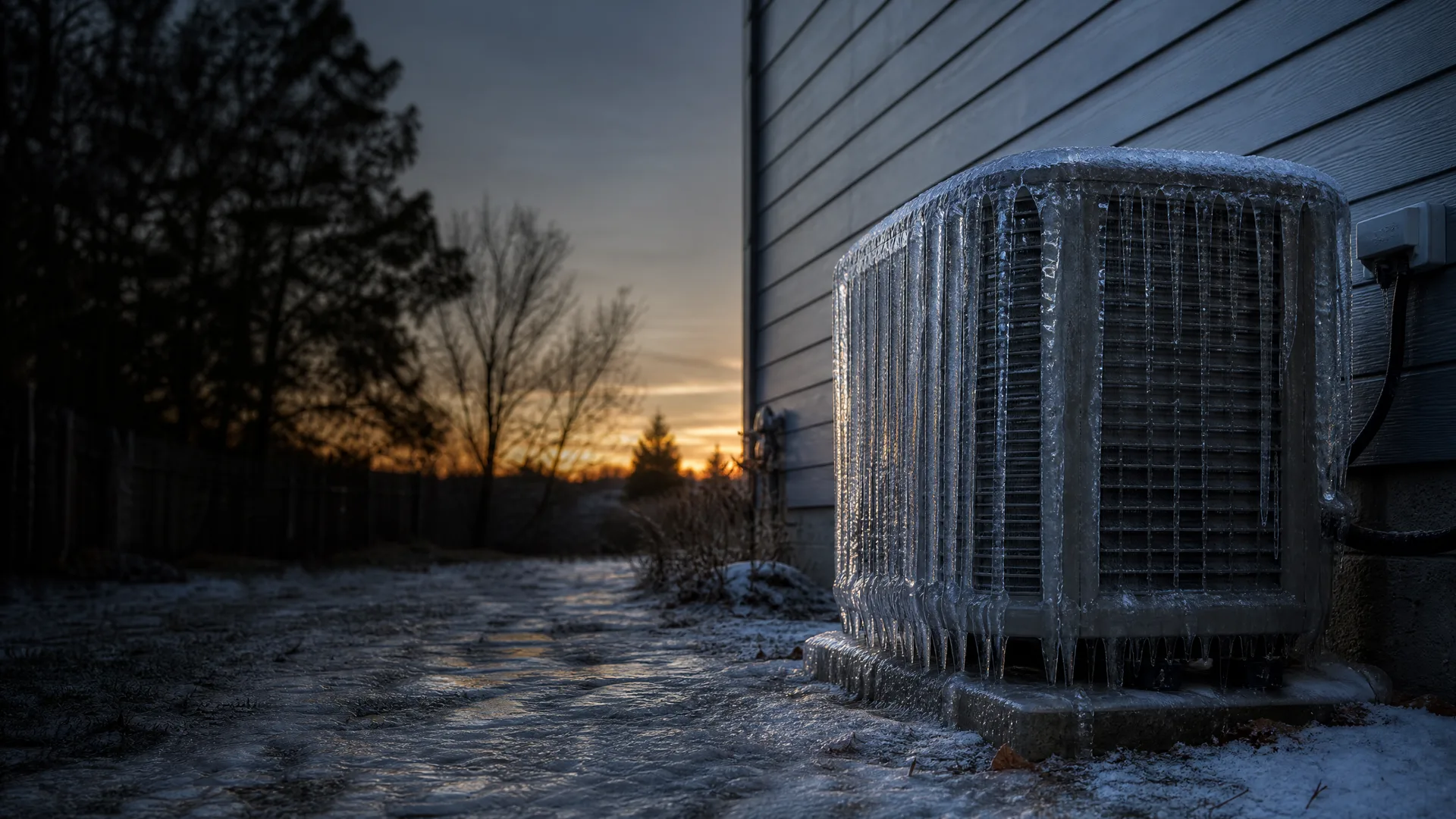
You go out for the paper a little after six and the sky is still that flat gray it gets before sunrise in January. The outdoor unit sits against the side of the house, and you notice it before you're even all the way down the steps. The whole cabinet is coated in ice, thick enough that you can't see the fan blades through the top grille. No hum, no air moving, nothing. You crouch down and knock a knuckle against the side panel and it sounds solid, like a cooler packed for a trip. Your breath fogs up in front of you while you stand there trying to decide if this is something that fixes itself once the sun's up, or something that needs a call before you head to work.
Call Now or Wait It Out
Call now
- A frozen or jammed fan motor can trip the breaker or strain the compressor if it keeps trying to run against resistance.
- A tech can tell within minutes whether it's a seized motor, a bad capacitor, or a stuck fan blade, instead of you guessing in the cold.
- Catching it early usually means replacing one part instead of a motor that burned out trying to push through ice or debris.
- Once the form is in, you're not the one calling around or explaining the same problem twice to different companies.
- If the unit is also your only source of heat right now, getting someone out sooner matters more than it would in July.
Wait and watch
- If the fan is just iced over from a normal defrost cycle, it may start spinning again on its own once that cycle finishes.
- A fan that's merely slow or noisy, not fully stopped, can sometimes hold on for a few more days without getting worse.
- Since most homes here heat with gas, a stalled heat pump fan in winter often isn't a no-heat emergency the way it would be in a summer cooling-only setup.
- Waiting means living with whatever noise or inefficiency the fan problem is causing until you do call.
- A motor that's struggling but not dead can fail completely without warning, turning a small fix into a bigger one.

Summer air here averages a 62°F dew point across June, July and August, per NOAA climate data for Iowa. That's heavy, sticky air, and your heat pump has to pull a lot of moisture out of it to keep the house comfortable. The outdoor fan runs long hours doing that work, and the motor and its bearings take the wear. That same fan is what you need spinning hard in January to defrost the coil. A motor worn down by a muggy summer is more likely to seize or stall the next time it's asked to work against ice. Once you send in the form, you're done tracking down who's free and who answers the phone. That part is off your plate.
NASA POWER T2MDEW county cells weighted by homes
Hand off the heat pump problem
A fan that won't turn doesn't fix itself by waiting, and running the system while it's stuck can burn out the compressor behind it. That's a heat pump, not a furnace, so it matters here even with gas heat in the house, since most Iowa homes lean on the furnace for the coldest stretches but still use the heat pump to handle the shoulder months. Cheap power doesn't help you if the unit can't run at all. Right now your options are to climb up and look yourself, not knowing what you're looking at, or call around to find someone who can come out, explain the same problem two or three times, and compare quotes while the unit sits there iced over. Send the request instead and that work is off your plate. You won't be sorting through contractors or repeating yourself on the phone. Someone who knows what a seized motor looks like takes it from here.
How the outdoor fan actually fails
- The outdoor fan is a direct-drive motor, so a slow or silent blade points to the motor or its capacitor, not a worn belt.
- A run capacitor stores the charge that kicks the motor into motion, and a weak one can leave the blade humming but not turning.
- Ice built up around the blade or the motor housing can physically block the fan even when power reaches the motor fine.
- The defrost board should reverse the system briefly to melt frost off the outdoor coil, and a failed sensor or relay there can leave the unit frozen instead.
- A motor that hums without spinning is usually still pulling power, which is why the breaker can trip if it's left running.
- Debris like leaves or ice packed into the fan guard can jam the blade without any electrical fault at all.
The outdoor fan is a direct-drive motor bolted straight to the blade, so there's no belt to wear out and slip the way an old furnace blower might. When the blade won't turn, the cause is almost always one of three things: the motor itself, the capacitor that starts it, or something physically stopping the blade from moving. The run capacitor holds the electrical charge that gives the motor its initial kick. A capacitor that's weakening can let the motor hum and vibrate without ever building enough force to spin the blade. That humming matters, because a motor in that state is usually still drawing power even though nothing is moving, and that's often what trips the breaker if the system is left running instead of shut off. Ice is the other common culprit here. Heat pumps are supposed to run a defrost cycle that briefly reverses the system to melt frost off the outdoor coil before it builds up around the fan housing. That cycle depends on a defrost sensor and a relay on the control board, and if either one fails, frost can keep accumulating until it physically locks the blade in place, even with a perfectly good motor underneath. Separately from ice, plain debris, leaves pulled in by the fan or packed snow in the guard, can jam the blade the same way, with no electrical fault anywhere in the system.




What are you noticing out there right now
You might hear the compressor running while the fan above it stays put, a low hum with no air moving. Or the whole unit went quiet, no hum at all, nothing. Some mornings the blade is caked in ice or snow and just can't turn. Some reach a hand near the cabinet and feel it's warm to the touch, or notice a faint burning smell, which points to a motor working against something it can't move. If the breaker has tripped more than once, the system has been trying to run without the fan, and that strain reaches the compressor next. A heat pump stuck like this on a cold day won't keep up, and the house will start to feel it.

Thermostat calls for heat, sending power to the outdoor unit.
The compressor starts and draws current through the fan circuit.
The run capacitor sends a jolt to kick the fan motor into motion.
A healthy motor spins the blade right away to move air across the coil.


Power costs 13.62 cents per kilowatt-hour statewide
At 13.62 cents a kilowatt-hour, running a heat pump in Iowa stays cheap next to propane or oil, which is part of why so many homes here pair one with a gas furnace. That rate doesn't change what a stuck fan needs, though. A motor that won't turn still needs a tech to open the unit and find out why.
EIA-861 2025 statewide residential average
A fan that won't spin is almost always a seized motor, a weak capacitor, or ice built up enough to jam the blade, and none of those get better on their own. You could spend the next hour searching for someone local who works on heat pumps, calling a few numbers, explaining what you heard and saw out there each time, then waiting on quotes to see who actually answers first. Or you could send one form and let that part be someone else's job. A licensed contractor can look at the motor, the capacitor, and the wiring behind it and tell you within minutes which one is the problem, instead of you guessing from the driveway. You still have a repair ahead of you, and nothing about that changes. What changes is that finding the right person to do it stops sitting on your plate the moment you send the request.





Send one request and you're done looking
Describe your heat pump job once, to one pro.
You're not committing to anything by asking.